Switchable Privacy Glass


Last Updated: October 26, 2026

Switchable privacy glass, also called smart glass or switchable glass, changes between translucent white and transparent when an electrical current is applied or removed. A wall switch or control system sets the state, so a window, door or partition can provide privacy without blinds or shades and still let daylight in. Two liquid crystal technologies are common: polymer dispersed liquid crystal (PDLC) and polymer stabilized cholesteric texture (PSCT).

How PDLC and PSCT glass work

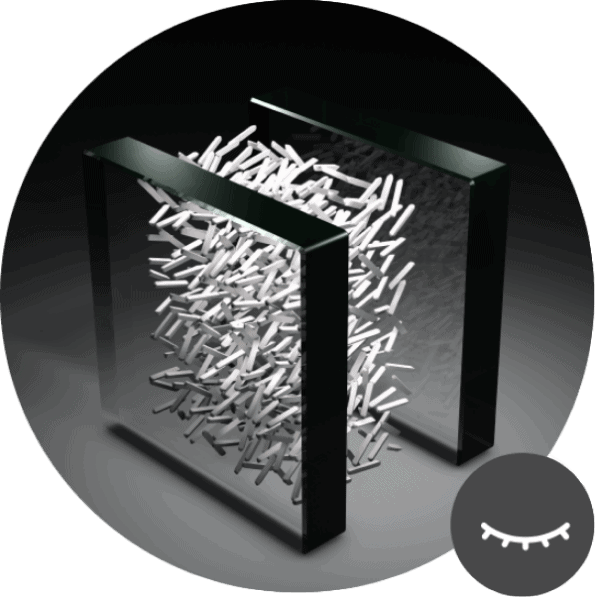
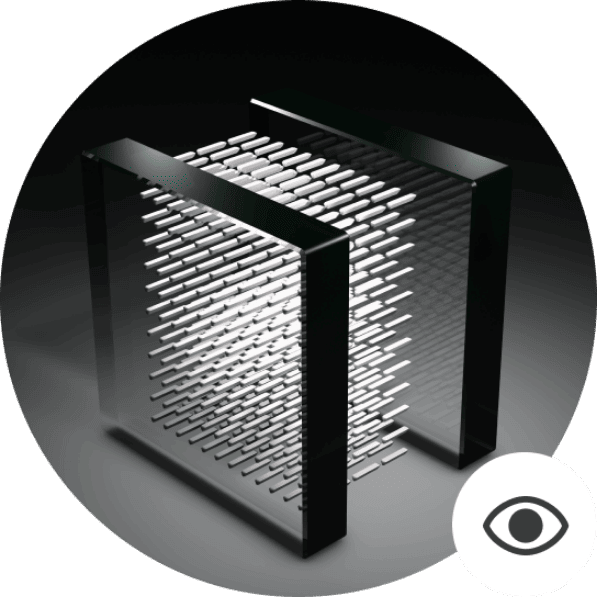
PDLC holds droplets of liquid crystal in a polymer layer, and PDLC products typically use a film laminated into the glass. With power on, the crystals line up and light passes straight through. With power off, they fall back into random orientations and scatter light, so the glass turns translucent.

PSCT uses cholesteric liquid crystals held in place by a polymer network. Power unwinds their helical structure and the glass clears. When power is removed, the helix re-forms and scatters light. PSCT gives better optical clarity than PDLC.

Private mode: liquid crystals scattered in random directions between two panes of glass

Private mode

Clear mode: liquid crystals aligned in rows between two panes of glass, letting light pass straight through

Clear mode

CLiC privacy glass from Cardinal

Compared with other privacy glass products:

  • The liquid crystal layer is applied directly to the glass with no film, so the unit is more durable than film-based products. In clear mode, CLiC is designed to show no visible haze, fogging or distortion, even at an angle.
  • In private mode, the glass scatters daylight and still lets it through, so the room stays bright.
  • PDLC-based products can require hours in private mode each day to keep their warranty coverage. CLiC has no such requirement, and its electronics are tuned for long service life.
  • CLiC runs on an NEC Class 3 low-voltage power system and works with third-party control systems in homes and commercial buildings.
  • Units are made to order within dimensional guidelines and can include LoĒ coatings, IG configurations, grilles and SDLs.